 |
OHLA
plastics Co., Ltd., established in the central Taiwan city of
Taiping, Taichung County in 1989, supplies plastic and metal
parts and accessories for the furniture industry. Five years
ago the company moved into a new 28,000-square-foot plant with
integrated production capabilities. The company says only the
most advanced management techniques are used at the plant to
boost productivity and quality. Of concern of late for OHLA
management are continuously rising prices for raw materials,
including plastics, iron, and steel. Iron and steel, polypropylene
(PP), acrylonitrile butadiene styrene (ABS), nylon, and polyethylene
(PE) are the main materials used in its furniture parts, and
all have become dearer in recent times. "The market is too competitive
for us to raise prices and recoup the higher costs," laments
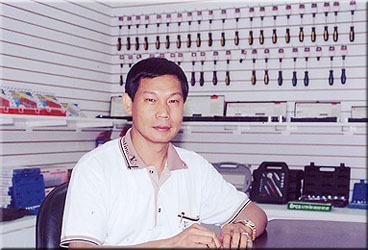
Chiang Ching-Shih, president of the company. "But we have made
every possible effort to keep costs down by streamlining our
production processes over the past several months. If prices
for raw materials doesn't rise too sharply in the future, I
believe we will weather this tough time." |
|
| OHLA's strategy
for success against cheaper mainland Chinese rivals has been to focus
on a wide array of self-developed niche items with higher margins.
Plastic-injection molding parts and DIY (do-it-yourself) iron-pipe
screws are two of OHLA's major product items. Other major products
include casters for office chairs, most of which are exported. Chiang
says that as a 30-year veteran in the plastic and metal parts industry,
he knows how to quickly spot evolving market demands and turn out
items that meet them. For example, he can help customers reduce procurement
costs by singling out appropriate materials for use in the items they
order from OHLA. "Some customers are used to using specific high-price
materials," says Chiang. "But I know how to help them reduce costs
by using cheaper materials without compromising the quality of their
products." OHLA works with domestic providers of high-end surface-treatment
services to produce high-end metal parts. "Due to our long-term business
relationships, these providers can offer cost-effective services to
us," says Chiang. "This helps us to achieve high quality at a low
cost. Anyone who wants to procure price competitive plastic and metal
parts for the furniture industry will find we can provide such services
in Taiwan, rather than in mainland China." |
| |
Hand Tools
The strong support of surface-treatment providers in Taiwan has also
eased OHLA's recent entry into the hand-tool market, including screwdrivers,
socket wrenches, and bits. Chiang says his firm has received several
big-ticket orders from home and abroad, attesting to the success of
the company's focus on high-quality products. In order to meet the
rising demand for its hand-tool line, OHLA is thinking of setting
up a new plant near its current factory. The company estimates that
the new production site will come on-line within the next two years.
Although the overseas market is much bigger than the domestic one,
Chiang says that his company won't sell its innovative plastic parts
to foreign markets so as to protect the interests of its domestic
customers in the furniture industry. "Our sales growth over the past
decade owes much to our domestic customers. To enter the wider global
market, we have started production of hand tools and expect this to
become one of our major products in the next few years." Chiang says
his company will begin more aggressively promoting sales of its hand
tools next year. "We have established a good environment for the production
of hand tools through research and development work over the past
year," says Chiang. "For instance, one of the handles of our screwdrivers
has been patented in the U.S., and we are waiting for approval of
several other patent applications." In addition to entering the hand-tool
market, OHLA has been developing innovative plastic parts for the
furniture industry since its establishment. The company also welcomes
original designs from customers. "By cooperating with foreign manufacturers,
we can effectively expand our line of plastic parts and meet the needs
of the international market," Chiang says. Seeing the booming demand
for surface treatment services in the mainland China, OHLA and another
Taiwanese company have set up 50-50 joint venture firm in Kunshan,
Jiangsu Province to provide such services. The company has just opened
a new plant specializing in metal-surface treatment. According to
Chiang, the plant uses the most advanced Taiwanese technology in the
field of surface treatment. "As Taiwanese technology in surface treatment
is highly regarded around the world, our involvement in this field
in mainland China will, I am fully confident, help us generate considerable
profits in the next few years." |
| |
|